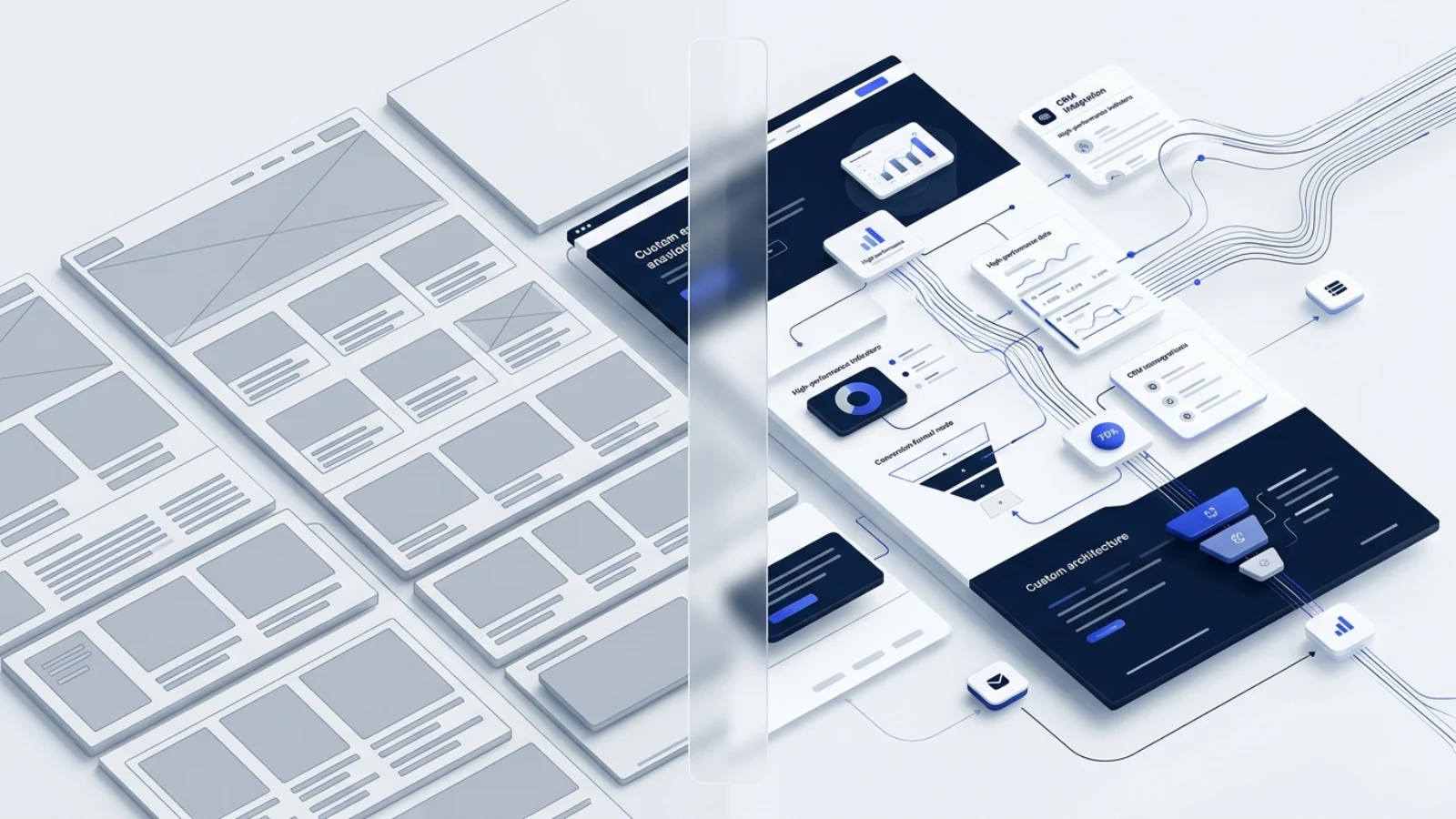
Custom Website vs Template Website: Which Is Better for Your Business?
If your website only needs to prove that your business exists, a template may be enough. If it has to rank in competitive search results, generate qualified leads, connect with your CRM, support paid campaigns, and keep working as the business grows, the decision deserves more scrutiny.
For most established businesses, the custom website vs template question comes down to control. A custom build gives you more control over site architecture, performance, conversion paths, integrations, tracking, and future changes. A template gives you a faster starting point with built-in limits. But which one is better overall? This guide tells you everything you need to know before making that important decision for your business.
What Is Different Between a Custom Website and a Template Website?
A template website starts with a prebuilt layout or theme. Platforms such as WordPress, Wix, Squarespace, Shopify, and Webflow can give you ready-made page structures that are adapted with your branding, images, copy, and plugins.
On the other hand, a custom website starts with the business requirements. Navigation, content structure, page layouts, conversion paths, and technical setup are planned around what visitors need to do and in this case, the business requirements determine the structure of the website.
Custom Website vs Template: Which One Has Better SEO?
A custom website does not receive a ranking bonus simply because it is custom coded. Google does not rank a site based on the invoice, the agency, or the label attached to the build.
Custom development gives you greater control over factors that can affect search performance. Developers can shape URL structure, internal linking, schema markup, page templates, indexation rules, mobile behavior, image delivery, JavaScript, and server response without fighting a theme built for thousands of unrelated sites.
Google’s Core Web Vitals guidance currently recommends an LCP of 2.5 seconds or less, an INP below 200 milliseconds, and a CLS below 0.1. Those measurements cover loading, responsiveness, and visual stability, and a well-built template can meet them.
The SEO advantage becomes apparent when the website requires a specific architecture. A multi-location business may need service and location pages connected through clear breadcrumbs, LocalBusiness schema, and useful internal links. E-commerce may need product taxonomy for shoppers and crawlers. Real estate may need indexable neighborhood pages and IDX data without thousands of thin URLs.
Mirch Media’s guide to technical SEO and Google’s 2026 search changes goes deeper into crawlability, schema, content structure, and Core Web Vitals. For local businesses, the local SEO strategy guide explains how website structure works alongside Google Business Profile, reviews, and local relevance.
What Does a Template Website Really Cost Over Time?
The launch price is only the first website cost. You also pay for hosting, software subscriptions, premium plugins, maintenance, developer time, security work, and rebuilds after the site outgrows its original structure.
Templates often become expensive through workarounds. A business adds one plugin for forms, another for speed, another for schema, another for booking, another for analytics, then custom code to make those tools cooperate. Each addition creates another dependency that has to survive updates.
Custom websites have ongoing costs too. Hosting, maintenance, security, content changes, and development remain. The financial advantage comes from a foundation that can accept planned changes without repeatedly rebuilding the same pieces.
When Is a Template Website Enough?
A template can be a sensible choice when your requirements are simple and likely to stay simple. A new business that needs a five-page brochure site, basic contact form, operating hours, gallery, and clear service information may gain little from paying for a complex custom build.
Templates also make sense for temporary campaigns, proof-of-concept businesses, event pages, and projects where launch speed matters more than deep technical control.
The mistake is expecting a basic template to behave like a custom business platform after the scope changes. A site that began as Home, About, Services, and Contact can become difficult to manage once it has twenty service pages, multiple audiences, paid landing pages, gated content, and automation.
When Does Custom Website Design Make More Sense?
Custom development becomes more valuable when the website has a job beyond presenting information.
You should seriously consider custom web design if the site needs to support competitive SEO, multiple locations, complex navigation, custom lead forms, e-commerce workflows, membership features, booking, dashboards, portals, APIs, CRM integrations, or business-specific data.
Industry requirements matter too. A healthcare practice may need accessibility, scheduling, privacy controls, and clear patient journeys. A law firm may need practice-area architecture, attorney pages, local search structure, intake tracking, and conversion paths. A real estate business can require MLS or IDX integrations that change the entire technical design.
What Changes When Your Website Has to Generate Leads and Revenue?
A revenue-focused website has to answer three questions quickly: where did the visitor come from, what do they need, and what should happen next?
That affects design decisions that templates often treat as decoration. Service pages need a clear path to inquiry. Paid-ad landing pages need message continuity from the ad to the form. Tracking has to record useful conversions, not just pageviews. Mobile forms need to be easy to finish. Calls, forms, bookings, and CRM records need consistent source data.
The same principle applies after a lead converts. If a form submission sits in an inbox for six hours, the website technically worked, and the business still lost the opportunity. Mirch Media’s guide to marketing automation and lead follow-up explains how forms, SMS, email, calendars, and CRM pipelines can work together as a single, connected system.
Conversion work can expose template limits. A business may need different calls to action for different services, audiences, or traffic sources. E-commerce may need checkout changes based on abandonment behavior. The e-commerce CRO guide covers the friction points that matter after traffic reaches the site.
What Website Decisions Cause Expensive Rebuilds?
Choosing only by upfront price is the most common mistake. A low launch cost is useful only if the website can support the business's next phase.
Another mistake is assuming “custom” automatically means fast, secure, accessible, or SEO-friendly. Ask how the site is tested, who owns the code and accounts, how redesign redirects are handled, how analytics is configured, and how future pages are created.
Ownership deserves attention. Know who controls the domain, hosting, CMS, analytics, Search Console, Tag Manager, source code, paid plugins, and third-party accounts. Changing agencies should not require a rebuild because the previous vendor controls the keys.
Redesigns also need migration planning. Changing URLs without proper redirects can erase years of search equity. Replacing forms without testing conversion tracking can make lead volume appear lower, even when the business receives the same inquiries.
Which Website Should Your Business Choose?
Choose a template when the website is simple, time-sensitive, and unlikely to require unusual functionality. Choose custom development when the site is expected to support search growth, paid acquisition, lead generation, integrations, complex content, or frequent expansion.
For an NYC business, competition raises the cost of weak execution. Your website may be compared with several nearby businesses before a prospect calls anyone. Speed, trust, clear service information, mobile usability, local relevance, and easy contact paths all affect that decision.
The 2026 web design trends guide covers the current expectations around performance, accessibility, responsive design, and user experience. Those standards matter regardless of how the site is built.
Frequently Asked Questions
Is a custom website better for SEO?
It can provide better technical control, but custom code does not guarantee rankings. Search performance still depends on crawlability, useful content, site structure, links, page experience, authority, and how well the site answers search intent.
Do template websites hurt Google rankings?
No. A well-built template website can rank. Problems arise when the theme results in slow pages, poor mobile performance, bloated code, weak site architecture, duplicate content, or limitations that prevent necessary technical changes.
Is custom web design worth it for a small business?
It depends on what the website must produce. If a small business depends heavily on Google visibility, paid traffic, booked appointments, online sales, or CRM workflows, custom development can justify the higher initial investment.
Can a WordPress website be fully custom?
Yes. WordPress can run a custom theme and custom page templates built around a specific business. Using WordPress does not automatically make a website template-based.
Can you move from a template website to a custom website later?
Yes, but plan the migration carefully. URLs, redirects, metadata, analytics, forms, structured data, and high-performing content need to be preserved so the redesign does not create avoidable SEO and tracking losses.
Custom Website vs Template: Make the Decision Around the Business
The custom website vs template decision gets easier once you judge what the website has to do, not just how the homepage looks.
If your site must compete in search, generate leads, integrate with your sales process, and scale without constant workarounds, custom development gives you greater control over long-term performance as your requirements become more complex.
Mirch Media has been building websites from Forest Hills, Queens, since 2006. If you want a practical review of your current site before deciding what to rebuild, book a free 30-minute website audit through Mirch Media’s NYC web design team. No pressure. You will get a clear view of what is working, what is limiting growth, and what should be fixed first.